
|
Getting your Trinity Audio player ready...
|
by JENN WOOD
***
Attorneys for accused killer Alex Murdaugh are asking a South Carolina judge to compel production of the underlying data extracted from cellphones seized during the state’s investigation of the murders of his wife and younger son.
In a motion filed Monday (September 28, 2026), the defense says it has received forensic reports generated from the phones of Maggie and Paul Murdaugh — but not the extraction files from which those reports were produced. Those files, attorneys argue, would allow their own examiner to test the cellphone timeline that figured prominently in Murdaugh’s first murder trial.
“The defense has the reports,” the motion states. “It does not have the data.”
The filing (.pdf) does not establish that the state’s cellphone timeline is wrong – or that the reports omitted evidence favorable to Murdaugh. His attorneys say they cannot answer those questions without first examining the underlying files.
Paul Murdaugh’s phone yielded the famous kennel video that placed his father at the Moselle crime scene shortly before he and his mother were gunned down on the evening of June 7, 2021. Murdaugh had previously claimed he was not at the scene of the crime in the moments before the murders. Data from Maggie Murdaugh’s phone — including its screen activity, steps and changes in orientation — also helped prosecutors construct their account of the final minutes before the murders.
Murdaugh was convicted of both killings in 2023. The S.C. supreme court reversed those convictions five months ago, determining former Colleton County Clerk of Court Rebecca “Becky” Hill improperly influenced the jury. Murdaugh’s retrial is scheduled to begin on April 5, 2027, in Sumter County.

***
WHAT THE REPORTS SHOW — AND WHAT THEY DON’T
According to the filing, prosecutors provided Cellebrite Reader and Magnet AXIOM reports generated from the seized phones, but did not provide the underlying extraction archives, associated keychain files or extraction logs for the devices identified in the defense’s request.
The defense describes an extraction as a copy of data acquired from a phone. Forensic software then processes that data into a report an examiner can read and present. Murdaugh’s attorneys contend the reports may leave out records the software did not parse – or an examiner did not select for inclusion.
They want their own expert to examine the source files for system records, metadata and potentially recoverable deleted entries — and to check how the state interpreted phone activity such as screen locks, steps and changes in orientation.
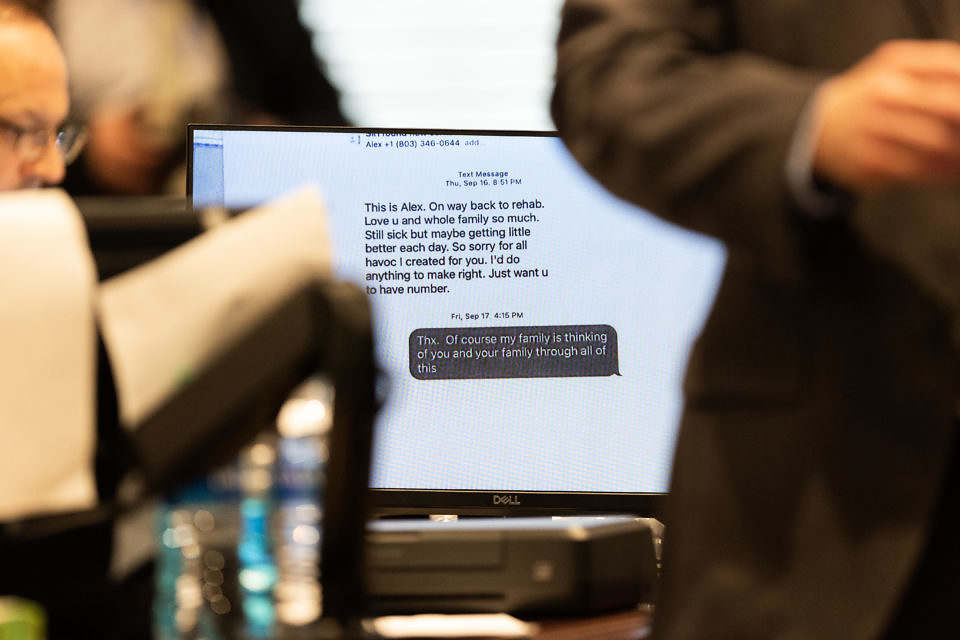
This is a distinction FITSNews has previously encountered in its reporting on the case. In 2025, our outlet identified text exchanges preserved in records from Alex Murdaugh’s phone that did not appear in the 88-page timeline (.pdf) special agent Peter Rudofski of the S.C. Law Enforcement Division (SLED) prepared for jurors. Those texts included exchanges involving Murdaugh’s longtime associate Curtis “Eddie” Smith in the days surrounding the murders. A subsequent report examined messages concerning an unidentified phone number.
Our reporting merely addressed discrepancies in what appeared in the timeline versus what was presented at trial. It did not establish that the messages were withheld from the defense. Monday’s motion raises a different question: whether defense experts have received the underlying extraction files needed to conduct their own examination of the phones seized in the investigation.
Murdaugh’s attorneys say they requested the files in writing on September 21 and asked prosecutors for a response by September 25. According to the motion, the state had not responded when the defense filed the motion on Monday.
The request covers extractions from Maggie Murdaugh’s iPhone and two phones belonging to Paul Murdaugh, including an extraction obtained by the U.S. Secret Service in 2022. It also seeks files from phones belonging to Timothy Gillespie and Christy Murdaugh, as well as a June 2021 extraction of Alex Murdaugh’s phone. The defense wants the logs and verification records associated with the extractions and an accounting of any additional attempts to extract data from those devices.
The filing points to prosecutors’ own August motion seeking access to an extraction of Alex Murdaugh’s phone performed by a defense expert. In that motion, according to the defense, the state argued that a full extraction can reveal deleted files and system data unavailable through a more limited examination.
Murdaugh’s attorneys say that same reasoning also supports their request to inspect the state’s extractions.
They further argue the state’s production of one extraction from Alex Murdaugh’s phone during the first trial came too late for meaningful review. The approximately 81-gigabyte archive was delivered on January 30, 2023 — the day before SLED’s cellphone examiner began testifying, according to the motion.
***

RELATED | Hidden Texts: What Alex Murdaugh’s Jury Didn’t Hear
***
ANOTHER FIGHT OVER UNDERLYING EVIDENCE
The cellphone motion follows a September 18 defense filing seeking additional DNA and ballistics records and the raw data from a three-dimensional scan of the Moselle crime scene. In both motions, Murdaugh’s attorneys argue they need access to the material buttressing the state’s conclusions to conduct independent analysis.
The filings also arrive amid a broader dispute over forensic evidence. As FITSNews previously reported, a defense motion accusing investigators of mishandling evidence connected to a bloodstain analyst was never decided before the first trial. Those allegations remain separate from the new cellphone request; and Monday’s motion does not allege that SLED fabricated phone data.
The defense has asked S.C. circuit court judge Debra McCaslin to hear the cellphone motion before the next scheduled hearing on November 13 and to order production within ten days of a ruling. It also wants prosecutors to explain in writing if any requested file or log no longer exists.
No ruling has been issued, and the motion presents only the defense’s account of what has been produced. With Murdaugh’s retrial scheduled to begin April 5, 2027, the immediate question for the court is whether his attorneys can examine the source data behind evidence the state used to establish its murder timeline.
***
THE LATEST MOTION…
Subscriber-only document
This PDF is available to FITSNews subscribers. Get full access and be able to view documents like this one.
Subscribe for accessAlready a subscriber? Log in here
***
ABOUT THE AUTHOR …
As a private investigator turned journalist, Jenn Wood brings a unique skill set to FITSNews as its research director. Known for her meticulous sourcing and victim-centered approach, she helps shape the newsroom’s most complex investigative stories while producing the FITSFiles and Cheer Incorporated podcasts. Jenn lives in South Carolina with her family, where her work continues to spotlight truth, accountability, and justice.
***
SOUND OFF…
Got something you’d like to say in response to one of our articles? Or an issue you’d like to address proactively? We have an open microphone policy! Submit your letter to the editor (or guest column) via email HERE. Got a tip for a story? CLICK HERE. Got a technical question or a glitch to report? CLICK HERE.

2 comments
SO – will these issues (among others – murder weapons’ whereabouts? ) be addressed in the scheduled status conference on Oct. 16? If not, why not? We are back-pedaling here …
Who is Timothy Gillespie?